
Traverse County Court Record Requests
Traverse County District Court keeps the trial-court record. It covers local civil, family, probate, juvenile, criminal, and traffic cases. For paper files, older material, certifications, and access problems that a remote search cannot solve, Court Administration is the working contact. Know what you want before choosing how to get it. A Register of Actions is the case's event history. An image, a calendar, a judgment search, and a certified copy each serve different needs. They are not interchangeable products.
- Identify the county, case number and year if known, and the precise product: ROA, document, calendar, judgment information, plain copy, certified copy, or exemplified copy.
- For public remote material, use MCRO Case Search to reach the case detail and ROA, then use Document Search with the case number when a public image may be online.
- For the fuller electronic public view, use a courthouse public-access terminal. At the counter, Court Administration can address paper files, older records, certifications, or public material not available remotely.
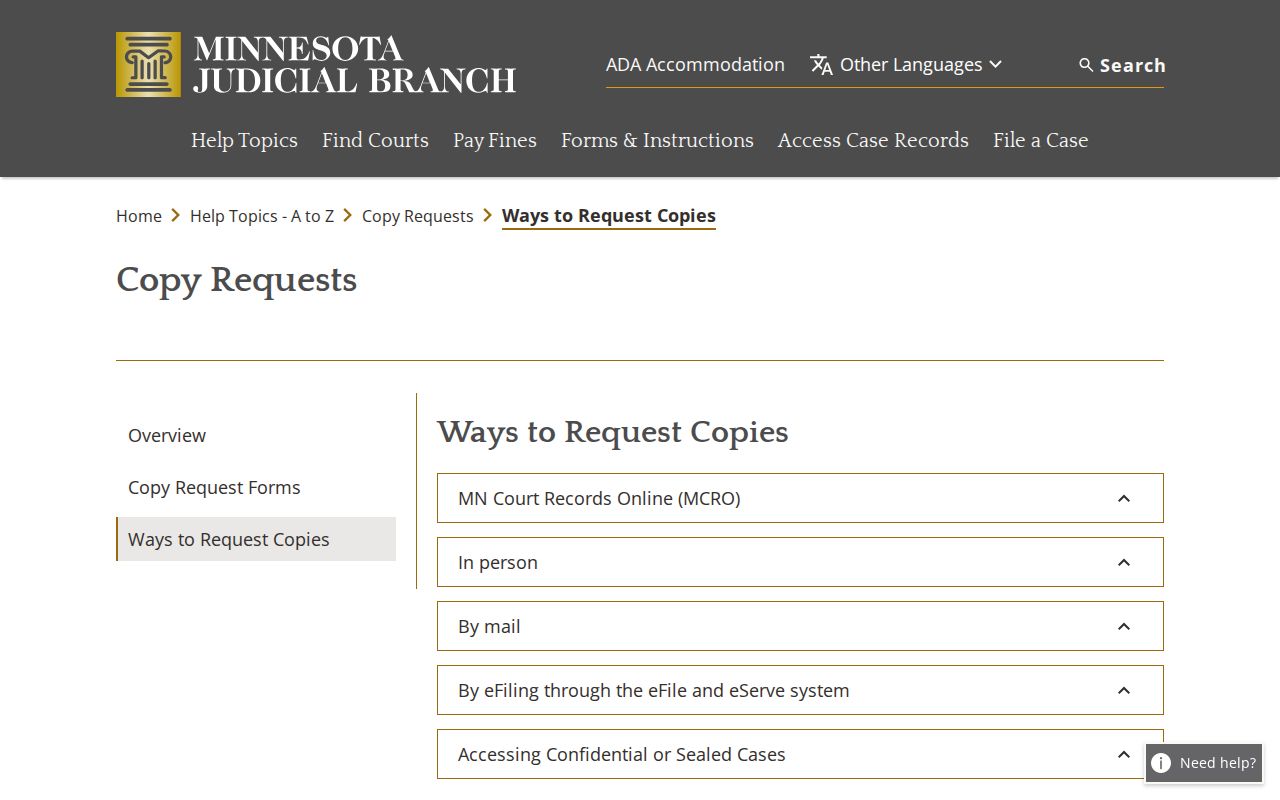
- For a copy request, submit the details in person, by mail, or through Minnesota eFS where appropriate. The statewide form is optional, so a complete letter is an acceptable starting point when no Traverse-specific form is available.
- Call Court Administration at (320) 422-6010 before sending payment or a mail request to confirm current fee, delivery, and certification instructions. For confidential material, use the CON100 and CON101 access-request procedure where applicable.
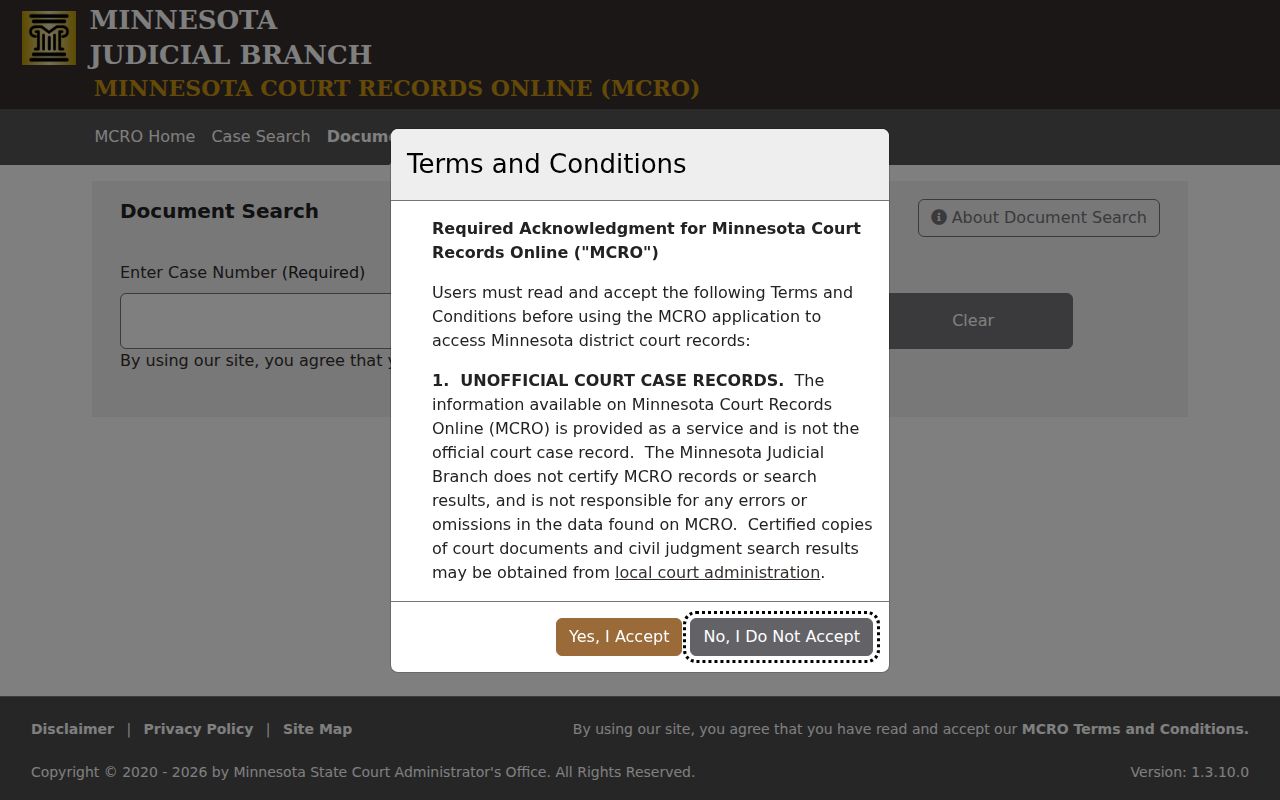
The official MCRO Document Search interface is the case-number route for available online documents.
A free online image can be handy when one exists. Viewing or downloading it costs nothing. Still, it is not a certified copy. And free remote access never promises that every document in the case file is available that way.
Traverse County Court Records by Mail
A mailed request should spell out the county, the case number and year, the item, format, quantity, your contact details, delivery preference, and payment method. Traverse County publishes no separate mailroom instructions or local copy-request form. So check mailing addresses and payment options with Court Administration before anything goes in the envelope.
Traverse County Court Records Channels
No single channel gives you the whole Traverse County court case record. MCRO is where remote searching starts. If the electronic record seems thin, try a courthouse terminal. The Minnesota Judicial Branch calls terminals the most complete electronic access option. Court Administration answers in-person and phone procedure questions. Mail and eFS cover written requests and eligible submissions. Traverse offers no fax, email, drop-box, or separate county records tracker. Do not count on those channels. The official copy-request forms page lays out the statewide form options.
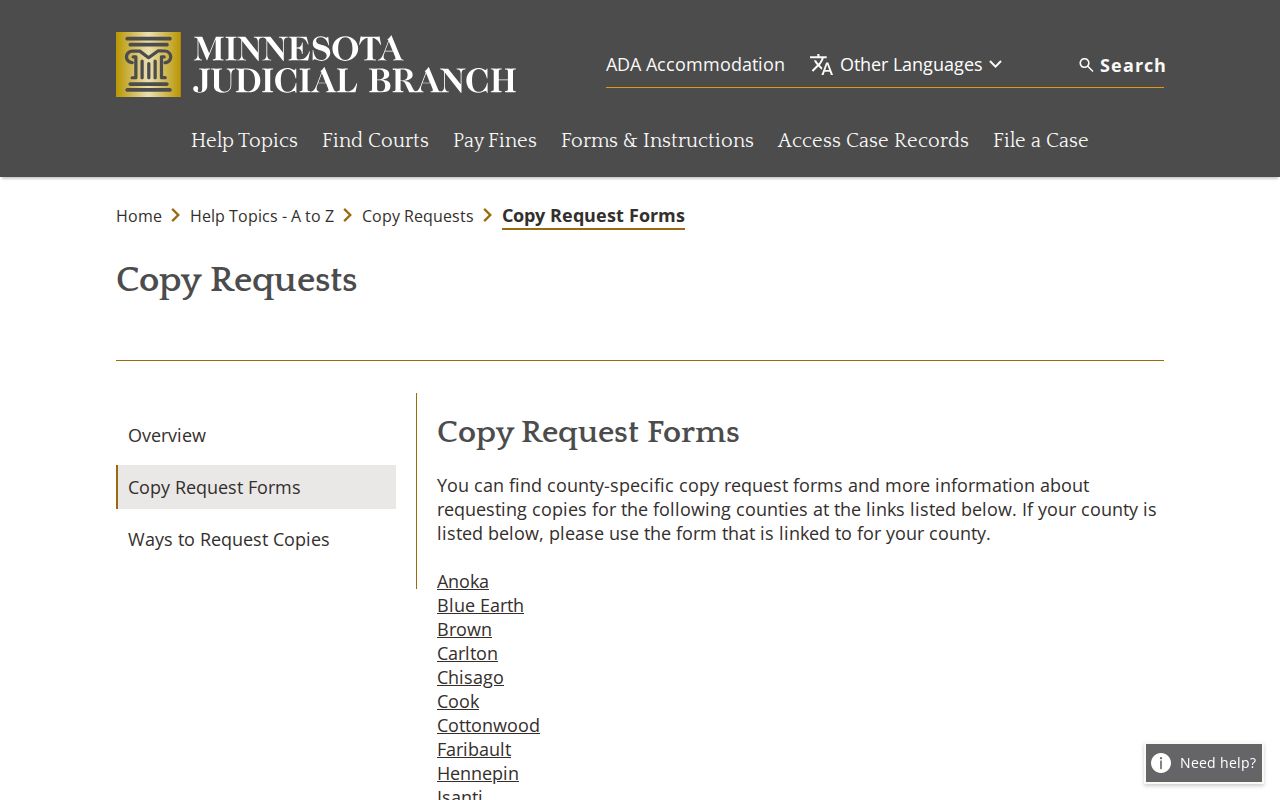
Traverse County publishes no downloadable request form of its own. Write the request out yourself. Include the court or county, the case number and year, the document title or description, quantity, format, contact details, delivery preference, and payment method. A phone call helps. It can confirm the process and the fees. It does not replace a written request when Court Administration needs details or payment on paper.
Kinds of Court Records
The wrong product wastes a trip or a stamp. A calendar only shows hearing settings on a given day. The Register of Actions lists every event in one case, in order. A document index points to filings and court-generated documents. Judgment Search is its own money-judgment route. A certified copy is the court's authenticated version of one chosen record. Name the exact item. Do not call them all a docket.
| Product | What it identifies or shows | Typical Traverse route |
|---|---|---|
| Register of Actions | Dated case events, settings, dispositions, and public financial entries. | MCRO Case Search, courthouse terminal, or Court Administration. |
| Document index or image | Public filing descriptions and links to remotely available documents. | MCRO Document Search by case number, terminal, or copy request. |
| Calendar or hearing setting | A planned hearing date, time, location, and type where public. | Daily calendar PDF, MCRO Hearing Search, printed calendar, or Court Administration. |
| Judgment record | Money-judgment information, debtor, docketed date, and status. | MCRO Judgment Search or Court Administration. |
| Certified or exemplified copy | A selected record authenticated by the court, with exemplification as a different product. | Court Administration after current verification. |
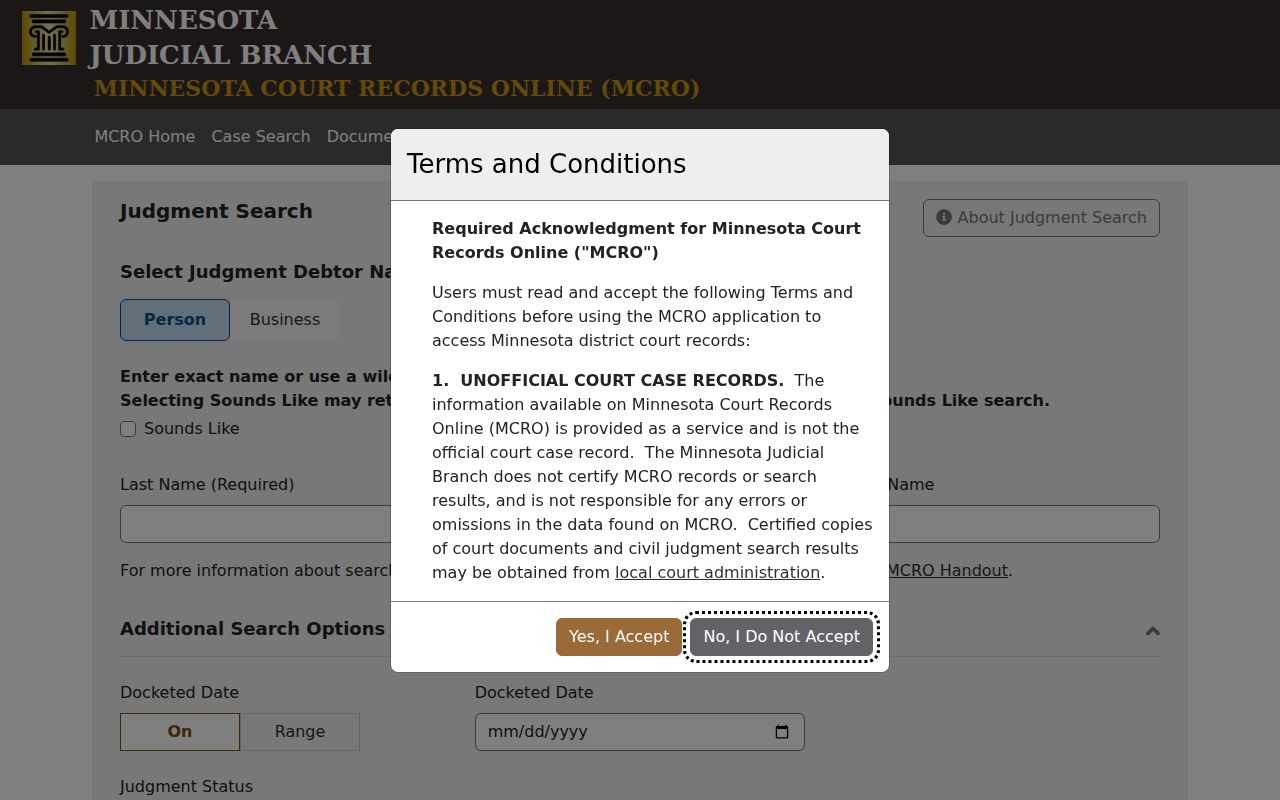
The MCRO Judgment Search screen is a separate public product, not a full case-history search.
A judgment entry is one piece of the story. To trace the full chronology of a Traverse County case, read the judgment result alongside the case detail in the docket rather than relying on that single money-judgment line.
Traverse County Court Records Products
What MCRO shows the public depends on record type, date, and access rules. The Judicial Branch says remote access covers many public major and minor civil and criminal documents filed on or after July 1, 2015, plus certain probate and court-generated family materials. Selected older judgments, orders, opinions, and notices appear too. Coverage is not a promise about any particular image.
One more wrinkle: documents filed through eFS stay visible to the filer in eFS for only 30 days. eFS is not permanent storage. The filing or service itself should still appear in the Register of Actions. Later access may mean a courthouse terminal or a copy request. When asking for a public document, give its exact title or description. Say whether you want plain, certified, or exemplified format.
Traverse County Court Records and eFS
For eligible filings and submissions, use Minnesota eFS. Filing there does not make a restricted record public. Keep your filer copies. Visibility in eFS ends after 30 days, and after that a terminal or copy request is the way back to the document.
Court Records: What They Contain
What a public Traverse County court case record actually contains depends on case type and access level. The ROA usually ties together the record header, parties or attorneys where public, dated events, hearings, disposition, financial information, and a public document index. A public result may be limited or redacted. A missing entry does not mean hidden details are lurking behind it. Do not read gaps that way.
| Case header | Case number, filing date, Traverse court location, category, and status when publicly available. |
|---|---|
| ROA chronology | Dated events, index numbers, hearings, settings, orders, and dispositions that the public record displays. |
| Party and attorney data | Roles and attorney or bar information where public, with protected personal data withheld or limited. |
| Document index | Descriptions of filings and links to public images only when the document is online and remotely available. |
| Financial information | Fines, costs, restitution, payments, judgment amounts, or balance when the case exposes those entries. |
| Restrictions | Redaction, sealing, confidentiality, and public-access indicators that can limit remote or terminal viewing. |
Traverse County Court Records Terminals
Minnesota courthouses have public-access terminals. The Judicial Branch calls them the most complete electronic access there is. Some material is older, restricted, non-imaged, or incompletely displayed. For that, the terminal at Traverse County Courthouse is the natural next stop. It cannot override a seal, a confidentiality order, or a Rule 4 restriction, though. Bring a case number or a precise party, citation, or record detail. Court Administration can then find the right product fast.
The courthouse sits at 702 Second Avenue North, P.O. Box 867, Wheaton, MN 56296. Court Administration hours run Monday through Friday, 8:00 a.m. to 4:30 p.m., per the official court page. A 2012 courthouse assessment noted an accessible annex entry and elevator route. Still, check current security rules before you go.
Traverse County Court Records Delays
Walk-in requests at the courthouse often finish the same day. Off-site or older files take longer to retrieve. So confirm timing with Court Administration before you count on a quick turnaround. Timing also hinges on the product itself. The public-access rule, any certification, payment, and delivery method all matter too. A search from home that comes back empty settles none of those questions.
Copy Fees and Certification
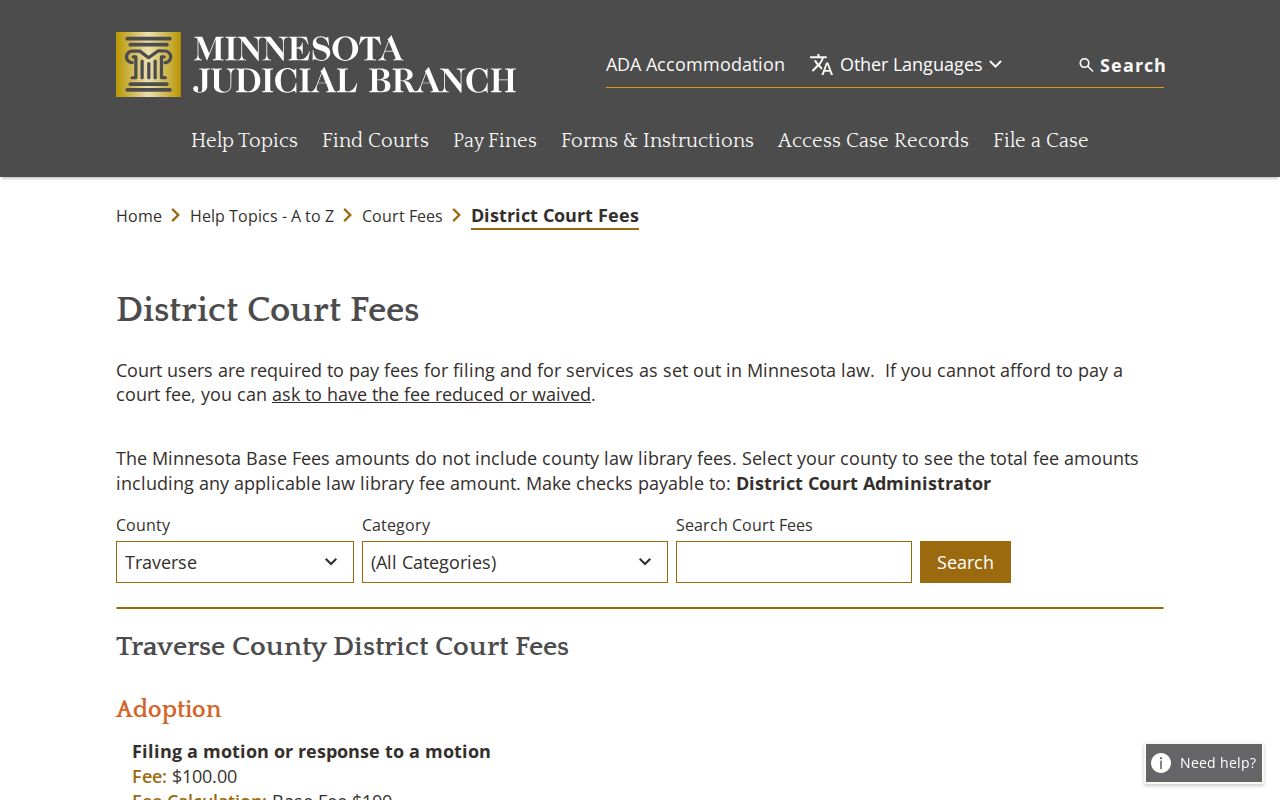
A plain MCRO image carries no court authentication. Need a certified or exemplified Traverse County court case record? Name the exact document first. Ask Court Administration whether it is available and what certification level fits. Ask for the current amount as well. The Traverse district-court fee page holds the figures. It should be rechecked before payment. That page notes base fees leave out a county law-library fee. Checks are payable to the District Court Administrator.
| Fee-page product | Displayed amount |
|---|---|
| Certified copy of any instrument | $14, subject to current verification |
| Certified printout of an imaged or e-filed document available from courthouse MNCIS | $14 |
| Certified scan, picture, or case-management screen print | $14 |
| Exemplified plus certified copy | $28, subject to current verification |
| Exemplified plus uncertified copy | $14, subject to current verification |
| Uncertified copy, printout, scan, or screen print | $0 displayed currently; confirm the product |
| Report, 1 to 50 pages | $5 per report, subject to current verification |
One warning about judgment searches. The current fee page lists $5 in one row, yet its calculation area shows a $55 base fee. Neither figure is safe to pick. Confirm the amount with Court Administration before paying. The official Traverse fee selector publishes the district-court fee schedule, including that judgment-search entry.
Old cached pages can quote outdated figures. Even the documented $14 certified copy calls for a fresh look at the current fee page before you send payment.
Traverse County District Court Administration
Traverse County Courthouse
702 Second Avenue North, P.O. Box 867
Wheaton, MN 56296
(320) 422-6010
Traverse County Court Records Confidentiality
Paying a copy fee unlocks nothing sealed. Confidential court records follow their own process. The CON101 form asks for the county, file number, judicial district, case type and name, the requester's interest, the detailed records sought, why they are needed, and signature and contact information. Adoption records sit outside that form entirely. Filing it requires no fee, the form itself says. Under the CON100 instructions, a judicial officer decides whether access is granted. The statewide copy-request guidance documents the in-person, mail, and eFS routes for requests the rules allow.
A grant of access is only step one. Copies are requested separately afterward. One CON101 can cover multiple cases within a single county, but a different county requires its own form. A court employee can explain procedure but cannot give legal advice, and in-person requests often finish the same day while an off-site file may take longer.
Access Rules for Court Records
Minnesota Judicial Branch rules govern access here. Traverse County runs no open-records portal of its own. Start with MCRO for public remote access. Then use the courthouse terminal for a fuller electronic view of court records. Paper files, older records, certified copies, and restricted material all go through Court Administration. Remote inspection, copying, terminal access, and certification are distinct levels.
Governing access rules. Rule 8 generally permits public inspection and copying but makes remote access and protected material narrower.
Rule 4 identifies court-record categories that are not accessible to the public. General Rule 11 addresses redaction and non-public filing treatment.
General Rule 14 governs electronic filing and service; it does not make restricted documents public. Minn. Stat. § 357.021 is the fee authority behind the court schedule.
Traverse County Court Records on Appeal
MCRO never holds appeals. An appeal does not enter the Traverse County district-court file. Neither do federal records. For a Minnesota appeal, use P-MACS, the appellate public-access system. It returns appellate case titles, numbers, parties, attorneys, docket entries, and certain post-2003 documents. Search with appellate case information. The trial-court MCRO number will not produce it. Federal civil, criminal, and bankruptcy matters run through the District of Minnesota PACER or CM/ECF system. A federal file at the regional Fergus Falls location stays federal. It is not a Traverse County court record. A local docket search may point to an appeal or federal matter. Those separate custodians and portals are the proper follow-up.